


Related

Electromagnetic Direction and Ranging (EMDAR) is a passive sensor technology that detects emissions along the EM spectrum to identify and track other vessel

Endeavour’s mission is one of exploration and discovery. In an unknown and distant environment however, the vessel must be able to defend itself if needed.
The Tactical Operating Environment (TOE) is the area of space surrounding the vessel that requires active management, due to possible navigational hazards or tactical threats. The TOE is defined by the range of tactical sensors, which locate and track non-mapped objects.
Depending on environmental conditions, the TOE extends to a radius of approximately 15 million kilometres.
Maintaining the TOE is the primary task of the vessel’s tactical team. This includes detection and tracking of unmapped objects around the vessel and if necessary developing firing solutions to any object deemed a threat to the vessel’s safety.
TOE Grid
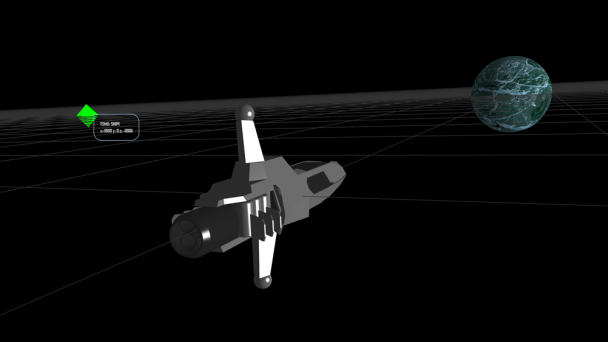
The TOE grid (example top right) represents the vessel’s operating environment. It displays all mapped astronomical objects such as stars, planets, moons and other major bodies, as well as any mapped man-made objects such as space-stations.
The TOE grid also displays any other objects detected by sensors and deemed to be of significance to the vessel’s operation (see TSMOs below).
The grid is oriented to the orbital plane of the star system currently being navigated.
TSMOs
Tactically Significant or Maneuvering Objects (TSMOs, pronounced sumo) are un-mapped objects detected in the vessel’s operating environment that are of tactical significance.
All maneuvering objects – objects capable of altering their own course - are of tactical significance because it is assumed that a maneuvering object is of artificial construction and therefore a vessel of some kind. Naturally occurring objects that are capable of maneuvering are extremely rare.
TSMOs are detected by EMDAR (see below) and designated as a 'track' (tracked contact) if considered significant. Once tracked, the TSMO is displayed on the TOE grid for as long as detection is maintained (or if the TSMO is undesignated).
Fixed objects or those with defined movement (such as an orbit) may also be of tactical significance either because they may represent a possible threat - such as a weapons or sensor platform (in the case of a satellite or unmapped space station) - or because they may provide cover from detection.
Detection
The goal of tactical sensor systems is to detect a threat TSMO before it can achieve counter-detection, without giving away the location of the vessel in the process.
EMDAR
Electro-Magnetic Direction and Ranging (EMDAR) is a passive sensor technology that detects EM emissions. The system is passive because it detects EM emitted by another vessel and calculates likely distance based on dispersal patterns. This is unlike an active sensor system that emits EM to bounce off a target, which is detected and analysed.
The advantage of the passive system is that it does not provide any EM emission for an opposing vessel to detect. The disadvantage is that passive systems can only achieve relatively weak readings, sometimes difficult to distinguish from background radiation. Dispersal patterns also become increasingly less predictable over distance, making range estimations less certain.
The EMDAR detection process is therefore as much an art as it is a science. It requires an operator to spot patterns across multiple windows and make accurate estimates as to whether that pattern is a vessel (TSMO). If it is, then estimates as to range, heading and speed will be needed to help the commanding officer make tactical decisions.
Contacts
Broadband EMDAR can detect EM from anywhere around the vessel. If EM is detected, the EMDAR crew will declare a contact to the bridge along with whatever information they can provide such as heading, range, maneuvering patterns, etc.
The contact will appear on the Contact Board along with range and bearing to its last identified location. This location is a point in space that represents where the crew thinks the contact is likely to be, which cannot be used to track the contact or target weapons.
Additional contacts will be added to the board over time, creating a pattern which indicates the contact's course.
Tracking
The crew will then work to refine the contact's suspected location until they believe they are close enough to attempt to track the contact using narrowband EMDAR.
Narrowband EMDAR provides greater detail from EM detections but only cover a narrow area of space. The improved EM analysis possible allows sensors to maintain contact with the contact as it moves, providing continuous updates on the contact's actual location.
If trained on an area of space that contains a contact the narrowband sensors will begin to track the contact, which is now referred to as a tracked contact (or "track").
Targeting
Once a TSMO's location is being tracked, it can be targeted by weapons systems.
Firing Solutions
A firing solution consists of information necessary to guide a torpedo to a contact if the need arises. This includes the TSMO’s bearing and its estimated speed and heading, as well as a definition of the search area the torpedo will use once it goes active.
This data only becomes a firing solution when the estimates are considered accurate enough to ensure a reasonable chance of a successful hit. This is determined by factors such as the strength of the EMDAR detection profile, range and the relative speed of the target and vessel.